

A warehouse packing steel profiles in eleven different lengths does not need eleven bag sizes. It needs one or two rolls of lay flat tubing and a heat sealer. That is the main reason buyers switch to roll-fed polyethylene: the packer makes a bag to fit each item instead of the stockroom carrying a bag for every SKU.
Tubing is only one of several formats made from the same blown film, though. How the film is slit and wound decides whether it suits hand packing, an automatic machine or covering large areas. Picking the wrong one is a common and expensive mistake, so here is how they differ.
How lay flat tubing works
Poly tubing leaves the extrusion line as a flattened tube and is wound onto a cardboard or plastic core. Both long edges stay closed. The operator pulls off the length needed, slides the product in, cuts the film and closes the ends with a heat sealer, tape or staples.
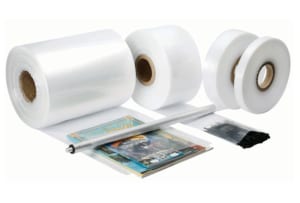
It earns its place with long, irregular or awkward goods: pipes, rods, extrusions, textiles, rolled rugs, mattresses and machine parts. Our article Plastic Tubing: The Flexible Packaging Solution goes further into the applications.
Tubing can also be perforated at fixed intervals with no bottom seal. Those open-ended pieces are sleeves. They tear off cleanly and slide over stacked goods or over a product that will be sealed later in the line.

The other roll formats, side by side
| Format | How it is made | Typical use |
|---|---|---|
| Lay flat tubing | Tube left intact, both edges closed | Made-to-length bags, hand packing |
| Single wound sheeting | Tube slit on both edges into two flat sheets, each on its own roll | Form-fill-seal and other automatic machines, lining, wrapping |
| Double wound sheeting | Film wound two layers thick on one roll | Covering large areas; opens to about twice the roll width |
| Centre-slit film | One layer cut along the middle | Opens into a sheet, or feeds machines that wrap from the centre |
| Gusseted tubing | Tube with folded side gussets | Boxed or square products that need extra volume |
Double wound sheeting is often sold for building and renovation covers, and in some markets width is quoted in inches and length in feet, so check which units your customers expect. For protective covering also see poly sheeting and pallet covers. Wide PE film is used in farming too; our guide to choosing greenhouse film covers that side.
Who buys it
Most orders come from makers of industrial parts and metal profiles, garment and mattress producers, furniture and flat-pack brands, and construction suppliers. Food and ice packers use it as well, but only in food-contact grades. On pallets, tubing and covers usually work alongside stretch film; if you are setting up a wrapping line, read our comparison of hand vs machine stretch film.
Tubing is not always the answer. For standard items packed in high volume, a ready-made bag is faster on the line. Examples are ice bags and self-sealing poly bags.
Writing the specification
A quote is only as good as the spec behind it. Work through these in order:
- Choose the format from the table above, based on whether people or machines will run the film.
- Set the lay flat width from your largest product, plus room to load it and to seal. If the film goes on a machine, check the maximum roll width, core size and roll weight it accepts.
- Pick the gauge in microns from product weight and how sharp its edges are.
- Choose the resin. LDPE is clear and seals easily, LLDPE blends add toughness, and HDPE gives stiffness.
- Add what the job needs: UV stabiliser for outdoor storage, anti-static, tint or opaque colour.
- Decide on print. Logos or handling marks repeat along the roll through custom printing; give the repeat length you want.
- Agree the packing: core size, roll weight, rolls per pallet and carton marks.
A useful check before you order is to measure the product’s girth rather than its width. Wrap a tape measure round the thickest point, halve it and add a few centimetres for loading clearance. That is your minimum lay flat width. Buyers who size from the flat face of a box often end up with tubing that will not slide over the corners. If several products are close in girth, we usually suggest one width that covers them all, so you stock fewer rolls.
From the Hanpak team
Hanpak supplies lay flat tubing rolls to the buyer’s width, gauge and print. MOQ is flexible and quoted per size and design, and every pack carries a lot number so a roll can be traced back to its production run. For food and ice applications, the resin complies with FDA 21 CFR 177.1520.
The same film technology goes into bin liners. Read why the same trash bag fails in different applications and our note on scented garbage bags.
Send us your product sizes
Share the dimensions of what you pack and the format you have in mind, and we will come back with a quote within 48 hours. You can request a quote or samples through our contact page or on WhatsApp. Samples are free.