

Most people picture a wrapped pallet when they hear the term, and that is indeed the biggest job. The full list of stretch film uses is wider: removal firms, furniture makers, steel and timber yards and e-commerce warehouses all go through rolls of it. What links them is the same property. The film is stretched as it goes on, then tries to recover, squeezing the load together without tape, glue or heat.
1. Unitising pallet loads
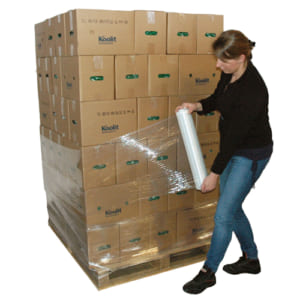
Cartons on a pallet behave as separate boxes until something ties them together. A few tight layers of film turn the stack into a single unit, so it survives forklift turns, braking trucks and the swaying of a container at sea. Wrapped loads also stack better in racking and are less likely to lean, which helps use warehouse height safely.
Low and medium volumes are usually wrapped by hand. Once a site wraps many pallets a day, a turntable machine pays off by applying film evenly and stretching it further, so less film goes on each load.

2. Removals and furniture protection
Removal companies wrap sofas, mattresses, table tops and cabinet doors before they leave the house. The film keeps drawers and doors closed, stops dust and rain getting into fabric and protects polished surfaces from scuffs. Because it sticks only to itself, it leaves no residue when it is cut away.
Furniture factories use it in the same way at the end of the line, often over cardboard corners or foam, to keep finished pieces clean on their way to the showroom.
3. Bundling long and loose items
Pipes, profiles, timber lengths, cable and rolled goods are awkward to strap. Narrow rolls of film, sometimes on a handle dispenser, bundle them quickly and hold them while they are moved or stored. The same trick works for grouping small cartons into a single outer pack for a courier.
4. Protecting industrial goods and machinery
Engine parts, panels and machines often sit in yards or containers for weeks. Wrapping them keeps out dust and moisture and reduces surface scratches. Coloured or opaque film adds a layer of privacy and makes it harder to see what is inside a load. For outdoor storage, UV-stabilised film lasts longer in sunlight, and a pallet cover on top keeps rain off the upper layer.
5. Colour coding in the warehouse
Black, blue or other tinted films let staff tell product lines, customers or quality status apart at a glance. Some exporters also use a coloured film to mark goods for a particular destination.
Different stretch film uses need different film
Different uses call for different film. A rough rule:
- Light cartons, hand wrapping: thinner hand film or pre-stretched film to save effort and material.
- Heavy or high-volume pallets: machine film with higher stretch and puncture resistance.
- Sharp edges or irregular loads: a tougher gauge, or edge protectors under standard film.
- Furniture and bundling: narrow rolls with a dispenser for speed.
- Outdoor storage: UV-stabilised or opaque film.
If loads arrive loose, check the bottom wraps before buying thicker film. We usually suggest two or three extra turns at the base so the film locks onto the pallet itself; that fixes many shifting problems at no extra cost per roll.
From the Hanpak team
Hanpak supplies hand and machine stretch film in clear and coloured versions, with roll width, length and core agreed with the buyer. Every pack carries a lot number, and production photos are shared while the order runs.
Find the right stretch film for your loads
Describe your loads and wrapping method and we will propose a film and quote within 48 hours. Trade terms are FOB, CIF or CFR, with payment by T/T or L/C. Request a quote or samples or chat with us on WhatsApp.