
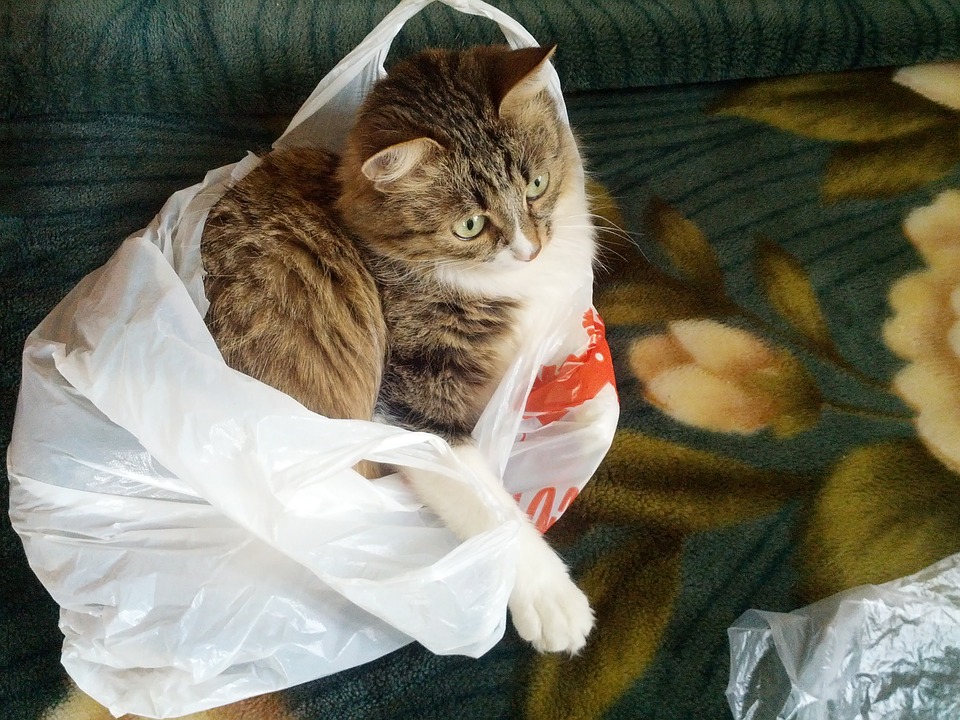
Shake out a fresh bin liner in a house with a cat and you will probably see a tail disappear round the corner. Leave the full bag by the door overnight, though, and the same cat may be nosing at the knot by morning. Cats have a complicated relationship with rubbish, and it says a lot about why household buyers increasingly choose scented trash bags.
This is a lighter post than usual on our News page, but there is a practical point at the end for retailers who stock bin liners.
The rustle problem
Cats hear far higher frequencies than people do, and a crisp plastic bag being snapped open produces a burst of exactly that kind of sharp, high sound. To a small predator that relies on hearing to stay safe, it is startling. Some cats also seem to remember a bad moment: a head stuck in a carrier bag handle, or a bag that moved when they jumped on it. Either way, the reaction is the same. Ears back, then gone.
Keep handles and loose bags out of reach for safety reasons too. Curious cats can get tangled, so store unused liners in a drawer or a box rather than in a loose pile.
Other household things cats would rather avoid
Bags are not alone. Thunder, fireworks and slammed doors send most cats under the bed, and a quiet, raised hiding place helps them settle. Pill time is another battle; many owners have more luck wrapping the cat loosely in a towel first so all four paws are tucked in. And then there is the litter tray. Cats are fastidious, and a tray that is not scooped often enough can push them to go elsewhere in the house.
Why the kitchen bin is so tempting
The fear of rustling plastic does not stop cats being drawn to the smell inside it. Fish skin, meat trays and tuna tins are irresistible to a cat’s nose, which is much keener than ours. A bin that smells strongly of food is an open invitation, and a thin bag that tears when pawed is a mess waiting to happen. Used litter adds its own odour problem if it goes into the general waste.
Where scented trash bags come in
Scented trash bags have a fragrance compounded into the film itself, so the scent is released steadily through the life of the bag rather than sprayed on once. They do not remove odour at its source, but they mask it well enough that the bin is less noticeable to people and, anecdotally, less interesting to pets. For pet households the sensible combination is:
- A bag thick enough not to puncture when a cat paws it or when tins go in.
- A closure that seals the top properly, such as a drawstring or a tie handle.
- A mild fragrance, since a heavy perfume can bother both owners and animals.
- Separate small bags for litter, tied off before they go in the main bin.
Our drawstring trash bags are a popular base for scented ranges because the closure keeps both smell and paws out. You can see the wider choice of sizes and formats in our trash bags category, and the trash bag size chart helps match bag dimensions to common kitchen bins.
A note for retailers
Shoppers with pets are a clear segment for scented liners, and fragrance is one of the easier ways to make a private-label range stand out on the shelf. Lavender, citrus and fresh-linen styles are common choices. When you brief a supplier, give the bag size, thickness, colour, closure type, the scent you want and how strong it should be, and the pack count per roll or box. Hanpak quotes MOQ per size and design, so testing one scented SKU alongside your unscented line is a realistic first step.
Fragrance fades with time and heat, so scent strength on day one is not what the shopper gets months later. If your stock will sit in a warm warehouse or travel a long way by sea, we usually suggest approving the scent on a sample that has been stored for a few weeks, and keeping rolls in their sealed inner bags until they reach the shelf.
From the Hanpak team
Planning a scented bin liner range?
Send us your spec and we will quote within 48 hours. Request a quote or samples through our contact page, or chat with us on WhatsApp. Stock samples are free.