

Cling wrap is a very thin food film (about 0.3 to 0.5 mil, or 8 to 13 microns) made to cover food, bowls and trays. Stretch film is a thicker LLDPE pallet wrap (usually 60 to 120 gauge, or 15 to 30 microns) made to hold a load together on a pallet. They look alike on the roll, but one is a food-contact product and the other is a transport packaging product, and you should not swap them.
We make both at Hanpak, for very different buyers. Below is how they really differ, with the numbers distributors and food buyers ask us for.

Cling wrap vs stretch film at a glance
| Cling wrap (food film) | Stretch film (pallet wrap) | |
|---|---|---|
| Main job | Cover food, bowls, trays; keep air off food | Hold boxes together on a pallet in storage and transit |
| Material | PE (LDPE/LLDPE) or PVC | LLDPE (cast or blown) |
| Typical thickness | Household rolls 0.3–0.5 mil (8–13 µm); US foodservice PVC rolls often 35 gauge (0.35 mil, about 9 µm) | Hand rolls 60–80 gauge (0.6–0.8 mil, 15–20 µm); machine rolls 70–120 gauge (0.7–1.2 mil, 17–30 µm) |
| Common widths | 12 in and 18 in (30 cm and 45 cm) | Hand: 18 in (500 mm). Machine: 20 in (500 mm) |
| Typical roll length | Retail boxes vary by brand; 18 in foodservice rolls are often 2,000 ft | About 1,500 ft for hand rolls; 5,000–6,000 ft for machine rolls |
| How it holds | Clings to itself and smooth surfaces, little tension | Stretched 100–300% on the load; elastic recovery squeezes the pallet |
| Food contact | Yes, made from food-contact material | Not intended for direct food contact unless made and documented for it |
| Packing | Cutter box (retail or foodservice) | Bare roll on a 2 or 3 in core (hand) or 3 in core (machine) |
Gauge, mil and micron are just three ways of saying thickness. 100 gauge = 1 mil = 25.4 µm, so 80 gauge stretch film is about 20 µm. US buyers order stretch film by gauge; European buyers order by micron. Give us either and we will match it.
Need stretch film or cling film?
We make hand and machine stretch film (50–200 gauge) and PE cling film for food, both made to order.
Request a quote or WhatsApp +84 898 545 893Material: why both are “polyethylene” but behave so differently
Cling wrap
Household cling wrap is either PE or PVC. PE wraps use LDPE, with LLDPE blended in to raise cling and tear strength. PVC wraps need a plasticizer to make the film soft and clingy, and they cling harder than PE. That is why PVC is still common on meat and deli trays in supermarkets, while PE is popular for retail household rolls.
The trend is thinner. Classic plastic wrap was about 12.7 µm (0.5 mil). Many brands now sell 8, 9 or 10 µm film because it cuts cost per roll and still covers a bowl fine.
Stretch film
Stretch film is LLDPE, a polyethylene made with butene, hexene or octene comonomer. Hexene and octene grades stretch further and resist punctures better, so they cost more per kilo but often use less film per pallet. Good stretch film can reach around 500% elongation at break. On a real pallet you stretch it 100–300%, and the film pulls back and holds the load tight.
Two production methods matter for buyers:
- Cast film: quiet off the roll, clearer, more consistent thickness, lower cost. Most hand and machine film in the US is cast.
- Blown film: tougher and clings better, better around sharp corners, but noisier and usually more expensive.

Stretch and strength
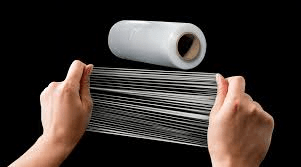
This is the real difference. Pull cling wrap hard and it thins out and tears. It is built to drape and stick, not to carry load. Stretch film is built to be pulled. US distributor listings rate 80 gauge cast hand film for loads around 2,000 lb, and 80 gauge cast machine film at about 2,500 lb, depending on the wrap pattern and how far you pre-stretch.
So the thickness gap (roughly 9 µm vs 20 µm) understates it. Stretch film resin is chosen for tensile strength, puncture resistance and elastic recovery. Cling wrap resin is chosen for clarity, softness and food contact.
Where each one is used
Cling wrap
- Household kitchens: covering bowls, wrapping leftovers and sandwiches
- Restaurants and catering: 12 in and 18 in foodservice rolls in cutter boxes
- Supermarket deli, produce and meat departments: over-wrapping trays
- Food processing: wrapping portions before boxing
Stretch film
- Warehouses and distribution centers: wrapping pallets by hand or on turntable wrappers
- Export: holding cartons together in containers
- Bundling pipes, lumber, furniture and long items
- Food and beverage pallets, wrapped on the outside of the cases
Can you use one in place of the other?
Cling wrap on a pallet: no. It is too thin and too weak. You would need many more wraps, it tears on box corners, and the load will lean or shift in transit.
Stretch film on food: not as direct food wrap. Standard pallet film is not sold as a food-contact product, and it may contain tackifiers and recycled content you do not want touching food. Wrapping a pallet of boxed food on the outside is normal. Wrapping bare meat or cheese with pallet film is not.
There is one grey area. Supermarket “stretch wrap” for meat trays is a food film, not pallet film. It is sold as cling film or foodservice film, often PVC. If a supplier calls something “stretch film”, check the spec sheet and the food-contact statement, not the name.
Buying tips for importers
- Specify thickness in one unit and stick to it. Gauge for US stretch film, microns for EU. Ask the supplier to print it on the carton label.
- Check net film weight, not just roll length. A roll can hit its length by running thinner. Weigh a roll without its core.
- For cling film, decide PE or PVC first. PE is plasticizer-free and suits household retail. PVC clings harder and suits meat trays. Then fix width, roll length and box style.
- For food film, ask for the food-contact statement. Our PE cling film is FDA-compliant food-contact material (21 CFR 177.1520).
- For stretch film, tell us how you wrap. By hand or machine, which wrapper, how heavy the loads, how sharp the corners. We often get a buyer onto a thinner gauge with a better blend, which means less film per pallet.
- Private label works for both. We print your cutter box design for cling film and your label or carton for stretch film. See our private label and printing options.
Our product pages list the popular specs by market: PE cling film and stretch film. Lead time is 4–6 weeks for a first printed order and 3–4 weeks for repeats.
FAQ
Is plastic wrap the same as stretch wrap?
No. Plastic wrap (cling wrap) is thin food film for covering food. Stretch wrap is thicker LLDPE film for holding pallet loads together. Some people say “stretch wrap” for meat tray film, which adds to the confusion, so always check the thickness and intended use on the spec sheet.
Is stretch film food safe?
Standard pallet stretch film is not made or sold for direct food contact. It is fine on the outside of boxed food on a pallet. For direct contact, use cling film made from food-contact material.
How thick is cling wrap compared with stretch film?
Cling wrap is usually 8–13 µm (0.3–0.5 mil). Hand stretch film is usually 15–20 µm (60–80 gauge), and machine film 17–30 µm (70–120 gauge). Stretch film is roughly two to three times thicker.
Can I wrap a pallet with kitchen cling film?
Only for something very light that is not leaving the building. Cling film tears on corners and has almost no holding force, so a real pallet load will shift.
What is the difference between stretch film and shrink film?
Stretch film holds a load by tension when you stretch it on. Shrink film is applied loose and then heated so it shrinks tight around the product. Stretch film needs no heat.
If you buy cling film or stretch film for distribution, send us your current spec: width, length, thickness, core and box or label. A photo of your current roll and carton works too. We will match it and send a free sample from stock. Send us your spec here.
Need stretch film or cling film?
We make hand and machine stretch film (50–200 gauge) and PE cling film for food, both made to order.
Request a quote or WhatsApp +84 898 545 893