
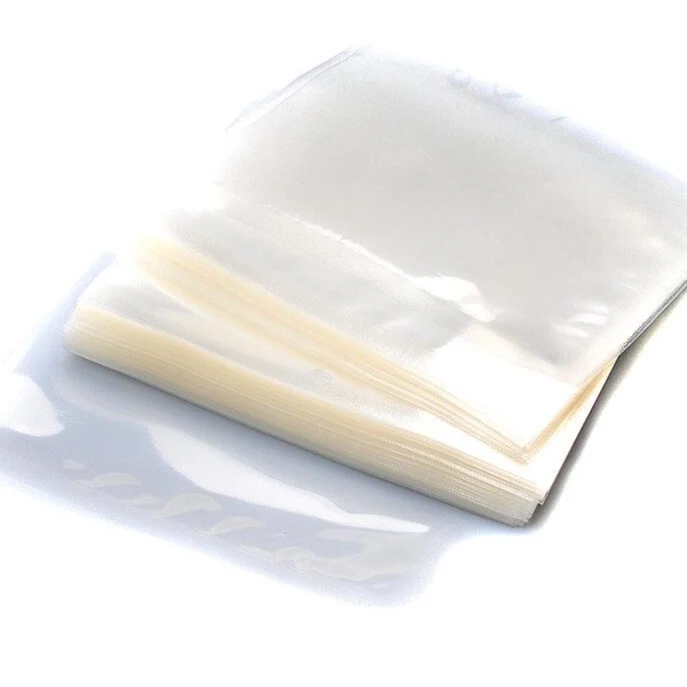
Most problems with vacuum bags for food packaging show up on the production floor, not in the lab: a bag that will not seal on the chamber machine, a pinhole from a bone edge, or a pack that slowly lets air back in on the shelf. Each one usually comes from a mismatch between the bag, the machine and the product.
This guide explains what the bag is doing, then works through those three matches.
What a vacuum bag actually does
Taking the air out of a pack removes most of the oxygen that drives spoilage. Many spoilage bacteria grow more slowly, fats oxidise less, colour and flavour hold better, and frozen products are protected from freezer burn. But removing air only helps if the bag keeps it out afterwards. Plain polyethylene lets oxygen through over time, so food vacuum bags are made from a laminated or co-extruded film, most often PA/PE. The nylon (PA) layer is the oxygen and puncture barrier; the PE layer is the sealing layer that melts and bonds under the sealing bar.
For processors and distributors, the result is a longer selling window, less waste, tighter packs that use less storage space and a clear, close-fitting look on the retail shelf.
Match 1: bag and machine
| Bag type | Surface | Machine | Typical user |
|---|---|---|---|
| Smooth (flat) bags | Smooth on both sides | Chamber vacuum machines | Meat plants, seafood processors, larger kitchens |
| Embossed (channel) bags or rolls | Textured on one side to let air escape | External or suction sealers | Small shops, home users, small producers |
Using a smooth bag in an external sealer is the most frequent cause of “the machine is not pulling vacuum”. Confirm the machine type before you approve a spec.
Match 2: bag and product
Soft products such as cheese, sliced meats or cooked foods can go into a lighter bag. Fresh fish, poultry pieces and bone-in cuts need more thickness and puncture resistance, and very sharp bones may still need a bone guard. Products for cook-in or sous-vide use need a film rated for that temperature. As a rough guide many buyers start around 60 to 70 microns for light duty, 70 to 90 microns for general meat and seafood, and heavier film for sharp or very heavy items, then confirm with trials on their own product.
Match 3: bag and supply chain
Chilled, frozen and ambient storage all stress the film differently. Frozen packs become stiffer and more prone to cracking at folds, so flex resistance matters. Long sea freight means more handling and more chances for abrasion. Ask for the bag size to leave enough headspace for a clean seal, and agree how bags are counted and cartoned so they arrive flat and clean.
Checklist for ordering vacuum bags for food packaging
- Structure: PA/PE, with the total thickness in microns.
- Format: smooth bags, embossed bags or embossed rolls.
- Size: width by length, including the seal margin.
- Use: chilled, frozen, ambient or cook-in.
- Print: plain, or printed with brand and product information.
- Paperwork: food-contact compliance and test reports for your market.
Hanpak supplies PA/PE vacuum bags in smooth and embossed formats. The PE resin for food-contact items complies with FDA 21 CFR 177.1520, and SGS test reports are available for many products; for others, SGS testing can be arranged on your order. If you sell under your own brand, see private label and custom printing, and our full product list covers related items such as ice bags for seafood packers.
If a buyer reports leakers but the film tests fine, we usually look at the seal area first. Fat, brine or meat juice on the inside of the mouth stops the PE layer bonding properly. A simple fix on the line is to fold the bag mouth back like a cuff while filling, then unfold it before sealing, so the sealing zone stays clean.
From the Hanpak team
Frequently Asked Questions
Can I use ordinary PE bags for vacuum packing?
For a short hold they will seal, but plain PE lets oxygen back in over time, so the shelf-life benefit is lost. For anything sold to customers or stored for weeks, a barrier film such as PA/PE is the right choice.
How long does an order take?
For bag orders, allow 4 to 6 weeks for a first order and 3 to 4 weeks for repeats, counted from sample approval. MOQ is quoted per size and design, and we work on FOB, CIF or CFR terms with payment by T/T or L/C.
Send us your vacuum bag spec
Tell us your machine, product and bag size and you will have a quote within 48 hours. Request a quote or samples online, or talk to the team on WhatsApp. Stock samples are free.