
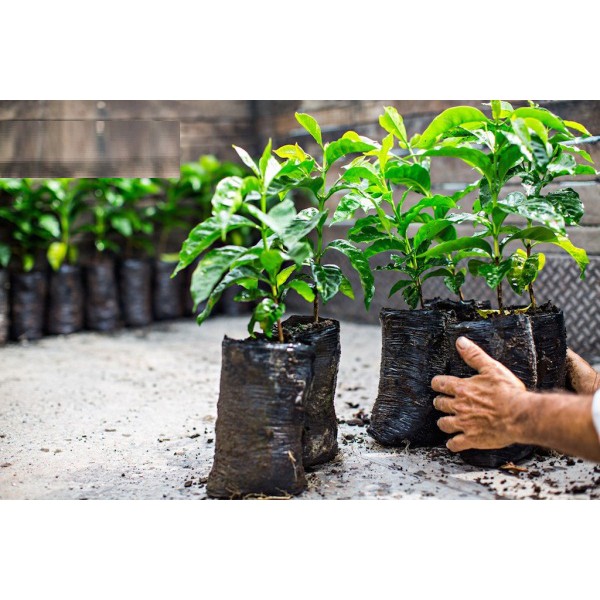
Seedling bags (also called nursery bags, grow bags or polybags) are soft, open-top polyethylene bags with drainage holes that hold soil for a young plant until it goes into the field or a bigger container. Small flat sizes around 8 x 14 cm (3 x 5.5 in) are used for germinating seed and rooting cuttings. Larger bags, sold in the US by gallon size, carry trees and shrubs for a season or more.
They are cheap, light and easy to space out on a bench, which is why tree nurseries, coffee and fruit growers and vegetable seedling producers use them by the million. Below is how they are built, how to size them, and what to put in a spec if you are buying them in volume.
What a seedling bag is made of
Most nursery bags are low-density polyethylene (LDPE) film, sometimes blended with LLDPE for stretch and tear resistance. LDPE stays soft, folds flat for shipping and does not crack when the bag is filled and moved. You will also see:
- Black/white co-extruded film. White outside, black inside. The white face reflects sunlight and keeps the root zone cooler. The black face blocks light from the soil, so algae and moss do not grow on the inside wall and roots are not exposed to light.
- Plain black film. The cheapest option and the most common. It blocks light well but runs hotter in full sun.
- UV-stabilized film. A UV inhibitor in the resin slows breakdown in sunlight. Without it, thin PE film turns brittle outdoors. If your plants stay in the bag for more than a few months in the open, ask for UV stabilizer.
- Non-woven fabric pots. Felt-like polypropylene “fabric pots” are a different product. They breathe and air-prune roots, but cost more per unit than PE film bags.
Polypropylene (PP) film is rarely used for nursery bags because it is stiffer and goes brittle in the cold. “Biodegradable” seedling bags exist, but read the claim carefully. A bag that breaks down in the soil after transplanting is very different from one that only fragments in sunlight.
Seedling and nursery bag sizes
US retailers sell grow bags by nominal volume in gallons and usually list the filled dimensions. Asian and African nurseries more often order by flat size in centimeters (width x height laid flat, before filling). The table below gives typical filled dimensions from US retail listings. Treat them as a guide, since each brand measures slightly differently.
| Nominal size | Approx. filled size (W x D x H) | Typical film thickness | Common use |
|---|---|---|---|
| 1 gallon (about 3.8 L) | 5 x 5 x 10 in (13 x 13 x 25 cm) | about 2.4 mil (60 µm) | Seedlings, herbs, rooted cuttings |
| 3 gallon (about 11 L) | 7.5 x 7 x 12.8 in (19 x 18 x 33 cm) | about 3 mil (76 µm) | Young shrubs, peppers, tomatoes |
| 5 gallon (about 19 L) | 8.5 x 9 x 15.5 in (22 x 23 x 39 cm) | about 3 mil (75 µm) | Fruit tree whips, larger vegetables |
| 10 gallon (about 38 L) | 14 x 12 x 20 in (36 x 30 x 51 cm) | about 4 mil (100 µm) | Trees held for a season or more |
| 30 gallon (about 114 L) | 20 x 19 x 28 in (51 x 48 x 71 cm) | varies by brand; heavy gauge | Specimen trees, large shrubs |
For seed germination and cuttings, nurseries in the tropics often use small flat sizes between roughly 6 x 12 cm and 20 x 30 cm. A coffee or citrus seedling usually needs a deeper bag than a vegetable transplant, because the taproot goes down before the plant is moved.
Thickness: mil vs. microns
1 mil is one thousandth of an inch, or 25.4 microns (µm). A 2 mil bag is about 50 µm, 3 mil about 76 µm, 4 mil about 100 µm. Small seedling bags that only live a few weeks can be thin. Bags that carry a tree for a year, get handled by a forklift crew and sit in full sun need to be thicker and UV-stabilized.
Why growers use bags instead of rigid pots
- Cost and freight. Empty bags ship flat. One carton of bags replaces a pallet of stacked rigid pots.
- Spacing. Bags can stand shoulder to shoulder on a bed, which fits more plants per square meter than round pots.
- Moisture. The film wall does not lose water through the sides the way clay or fabric does, so the soil stays wetter between watering.
- Transplanting. At planting time you slit the bag and lift the root ball out whole. Roots are less disturbed than when seedlings are pulled from a bare-root bed.
- Weeds and pests. Each plant sits in its own soil, so weeds and soil pests do not spread from row to row as easily as in an open seedbed.
The honest trade-offs: PE film bags are mostly single-use, roots can circle in a smooth-walled bag if a plant is kept too long, and thin black bags can overheat roots in hot climates. That is the reason black/white film and UV stabilizer exist.
How to use a seedling bag
- Check the drainage holes. Most bags are punched with small holes in the lower third. If yours are not, punch some before filling. Standing water rots roots fast.
- Fill with a loose, well-drained mix. Fill to about 2–3 cm (1 in) below the rim so water does not run off the top.
- Firm the soil lightly. Tap the bag on the bench so the mix settles and the bag stands upright.
- Sow or transplant. Sow seed at the depth on the packet, or set the cutting or plug and firm around it.
- Water to keep the mix moist, not wet. Bags hold moisture longer than open beds, so check before watering.
- Give the right light. Put the bags where the seedlings get the light they need, with shade cloth in hot weather if the crop needs it.
- Transplant before roots circle. When roots reach the bag wall, move the plant up a size or plant it out. Slit the bag down the side and lift the root ball out in one piece.
Buying tips for importers and nursery suppliers
If you are sourcing nursery bags or film for a nursery chain, a forestry program or a farm supply business, these are the points that change price and performance:
- Flat size and gusset. Give width x height laid flat, plus bottom gusset if you want the bag to stand up when filled.
- Thickness. State it in mil or microns, and how long plants stay in the bag.
- Color. Black, or black/white co-extruded with white outside.
- UV stabilizer. Yes or no, and the expected outdoor exposure time.
- Drainage holes. Hole size, number and position (bottom only, or bottom and lower sides).
- Printing. Your brand, plant name or a fill line can be printed on the white face.
- Packing. Bundled flat, in cartons, with your labels and barcodes.
Hanpak’s agricultural range is film: agricultural film for mulching and covering, and UV-stabilized poly sheeting for greenhouse, ground cover and construction use. We blow PE film to custom width and thickness, so if you have a nursery bag spec, send it over and we will tell you straight away whether it fits our lines. For a sleeve that you cut and fill yourself, lay-flat poly tubing on rolls is another option.
FAQ
Are plastic grow bags better than pots?
For volume nursery work they are usually cheaper per plant, ship flat and pack tighter on a bed. Rigid pots last many seasons and hold their shape for retail display. Fabric pots give better root pruning but dry out faster. Pick based on how long the plant stays in the container and how it will be sold.
How long do polyethylene nursery bags last outdoors?
It depends on thickness and whether the film has a UV stabilizer. Thin black bags without stabilizer can turn brittle within one season in strong sun. UV-stabilized, thicker bags are made to be handled and reused, though most growers treat them as one-crop items.
What size seedling bag do I need for tree seedlings?
For germination and the first few months, small flat sizes in the 8 x 14 cm to 10 x 20 cm range are common. Deep-rooted species such as citrus or coffee need a taller bag. Move the plant to a 1–3 gallon bag once roots reach the wall.
Should the white side of a black/white grow bag face out?
Yes, for most outdoor use. The white face reflects sunlight and keeps the soil cooler, and the black inner face blocks light from the root zone.
Can plastic nursery bags be recycled?
PE film is recyclable in principle, but most US curbside programs do not accept film. Bags with soil left on them are refused by most store drop-off bins too. Ask your local recycler or ag-plastics collection program.
If you buy nursery bags, mulch film or sheeting in container volumes, send us your spec: flat size, thickness, color, UV requirement and how many holes you need. We will come back with what we can make, a sample from stock where we have it, and a quote on FOB, CFR or CIF terms.