
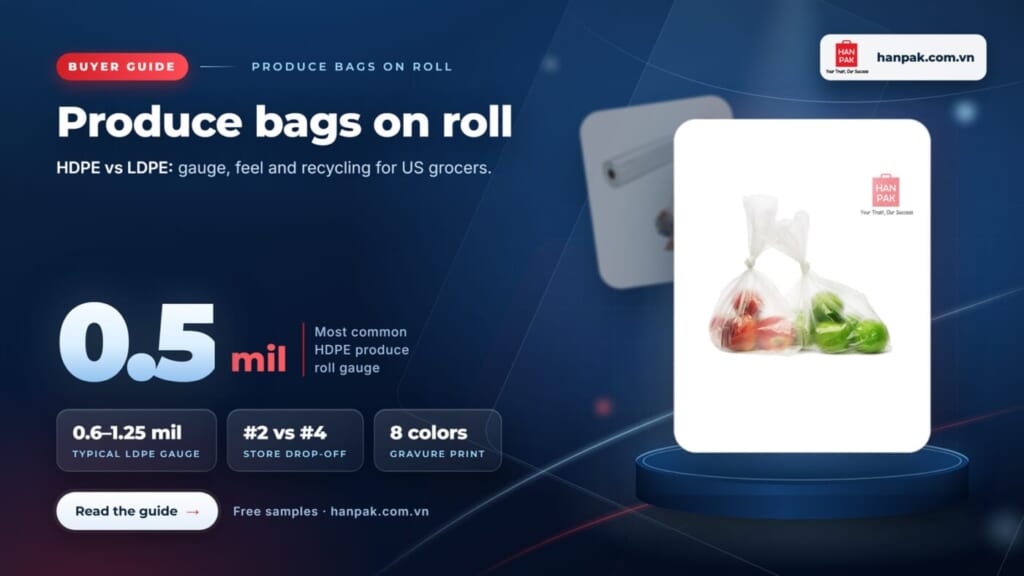
Most US grocery stores put HDPE produce bags on their rolls, and for good reason: HDPE carries a bunch of bananas at a very thin gauge, so each bag costs less. LDPE is the softer, clearer bag that some stores pay a little more for, because shoppers can see the fruit and the bag doesn’t crackle. Neither is “better”. The right choice depends on what you sell, who buys it and what your customers will put up with. Here is how the two compare on a roll, with the gauges and sizes US distributors list today.
We have a general guide to produce bags on roll and a post on LDPE and HDPE bags in general. This one is only about the produce roll decision.
HDPE vs LDPE produce rolls at a glance
| HDPE (high density) | LDPE (low density) | |
|---|---|---|
| Look | Translucent, slightly milky (“natural” or “clear” HDPE is still hazy) | Clear, glossy |
| Feel and sound | Crisp, crinkly, rustles when opened | Soft, quiet, a little stretchy |
| Typical US gauge on roll | About 6–14 micron (0.25–0.55 mil); 9–11 micron and 0.5 mil are the most common listings | About 15 micron (0.6 mil) up to 1–1.25 mil |
| Strength at low gauge | High tensile strength, holds weight even when very thin | Needs more gauge to carry the same load, but resists punctures and tears spread more slowly |
| Cost per bag | Lower, because less film goes into each bag | Higher, because the bag is thicker |
| Opening on the roll | Can be hard to open with dry fingers; often helped by a slip or “easy-open” finish | Opens more easily, film clings less to itself |
| Resin code | #2 | #4 |
| Lead time at Hanpak | Faster | Standard |
The gauge ranges above are what US distributors list for stock produce rolls (see sources). They are market ranges, not our specs. We make to the gauge you ask for.
Feel and clarity: what shoppers notice
Shoppers judge a produce bag in two seconds. They pull it, try to open it and drop the apples in.
HDPE is the bag most Americans picture: thin, crinkly, a bit cloudy. It does the job. The complaint we hear most is that it is hard to open, and you can’t see the fruit as well through it. At checkout the cashier can still read a PLU sticker through it, but not as easily as through LDPE.
LDPE is soft and quiet and you can see straight through it. It opens more easily and it gives a little when a pear has a stem or a corner of a clamshell pokes it. Stores that sell premium produce, organic sections and specialty grocers often choose it for that reason. It feels like a better bag, because it is a thicker one.
Strength at low gauge, and what that does to cost
This is where HDPE wins. HDPE film is stiffer and has higher tensile strength than LDPE, so a very thin HDPE bag still carries several pounds of potatoes. To get a similar carrying strength from LDPE, you need noticeably more gauge, often about twice as thick.
More gauge means more resin in every bag, and resin is most of what you pay for. So at the same size, an HDPE produce bag usually costs less per bag than an LDPE one. For a chain that hands out millions of bags a year, that gap matters more than anything else on this list.
The trade-off: HDPE is weak once it is punctured. A sharp corner starts a tear and the tear runs. LDPE stretches around the point and the hole stays small. If your customers bag things with stems, corners or rough skin, such as pineapples, broccoli crowns or bulk nuts with shells, LDPE gives fewer split bags.
Common US sizes
Produce bag sizes are given as width x length in inches. The sizes we see most often in US distributor catalogs are:
- 10 x 15 and 11 x 17: the everyday size for loose fruit and vegetables
- 12 x 17, 12 x 20: the most common “standard” roll in grocery stores
- 14 x 18, 14 x 20, 15 x 20: larger items, leafy greens, bulk buys
- 11 x 19 and 18 x 24: seen more in LDPE and in larger, heavier-gauge rolls
Most of these are standard because they fit the dispensers stores already have. Check your dispenser before you change size. We make almost every order to custom size, so if your stores run an odd width, we match it.
Roll formats: cored or coreless, flat or star seal
Cored rolls wind on a paper or plastic core and sit on a bar dispenser. Coreless rolls have no tube in the middle and leave nothing to throw away when the roll runs out. Which one you need depends on your dispensers, so measure them first.
Flat seal is a straight seal across the bottom. Simple, and it works on every dispenser. Star seal folds the bag before sealing, so the bottom opens round and spreads the load. A wide bag also fits on a narrower roll. We cover it in detail in our post on star seal produce bags on rolls. Both HDPE and LDPE can be made either way.
Printing
Many US produce rolls carry a message: “Fruits & Veggies — More Matters”, a suffocation warning, a store logo or recycling instructions. Both resins print well. HDPE’s hazy surface makes bright colors look slightly softer; on clear LDPE, colors stand out more but the print also shows any misregistration. We print by gravure up to 8 colors, matched to your Pantone references. Send artwork early so we can place the print to suit your roll width and seal type.
Food contact
Produce bags touch food, so the resin has to be right. Our food-contact items are FDA-compliant (21 CFR 177.1520), the US rule for polyethylene in food contact. That covers both HDPE and LDPE grades. Our plant works to ISO 9001 and JIS standards.
Recycling: #2 vs #4
HDPE is resin code #2 and LDPE is #4. That sounds like a big difference, but for thin film it mostly isn’t. Most curbside programs in the US do not accept plastic bags or film of either type. Both go to store drop-off bins, which take clean, dry polyethylene film, HDPE and LDPE together. If your store has a drop-off bin at the entrance, printing “Recycle at store drop-off” on the bag is a simple way to back it up. Rules vary by state and by program, so check local requirements before you print a claim.
Which one should you choose
- Choose HDPE if cost per bag is your main concern, you run high volume (mainstream supermarkets, discount grocers, foodservice), and your shoppers are used to the crinkly bag. It is also the faster option at our factory, which helps when you need to restock quickly.
- Choose LDPE if you sell premium or organic produce, your customers complain about bags that won’t open or that split on sharp items, or you want the fruit to show clearly through the bag.
- Not sure? Run both. Some stores put HDPE at the main produce wall and LDPE at the organic or specialty section. Ask us for samples of each and let your store managers try them on the floor.
Frequently asked questions
Is HDPE or LDPE better for produce bags?
HDPE is cheaper per bag and strong at thin gauges, so most supermarkets use it. LDPE is clearer, softer and better at resisting punctures, but it needs a thicker gauge. Choose by cost, product and how your shoppers react.
What thickness are produce bags on a roll in the US?
HDPE produce rolls are usually about 0.25–0.55 mil (6–14 micron), with 0.35–0.5 mil the most common. LDPE produce rolls usually run from about 0.6 mil to 1.25 mil.
Can HDPE produce bags be recycled?
Yes, at store drop-off bins that take clean, dry plastic film. Most curbside programs do not take film, whether it is HDPE (#2) or LDPE (#4).
How long does a custom produce roll order take from Hanpak?
Generally 4–6 weeks for a first order and 3–4 weeks for a repeat order. HDPE produce rolls usually come out faster than LDPE. Free samples are available before you order.
Tell us your size, gauge, resin and dispenser type and we will send samples and a quote. Find our produce bags on roll here, send us your spec, or WhatsApp +84 898 545 893.
Sources: WebstaurantStore, Inteplast 12×20 HDPE produce roll (9 micron); Imperial Dade, Novolex/Hilex 15×20 HDPE (6 micron); Imperial Dade, 12×20 HDPE (11 micron); US Polypack, 11×17 HDPE (14 micron); Interplas, 11×17 and 12×17 produce rolls (0.5 mil); Imperial Dade, Inteplast 12×20 LDPE (15 micron); Hillas, 11×19 low density (1 mil); Imperial Dade, 11×19 low density (1.25 mil); EcoEnclose on How2Recycle store drop-off for PE film.