
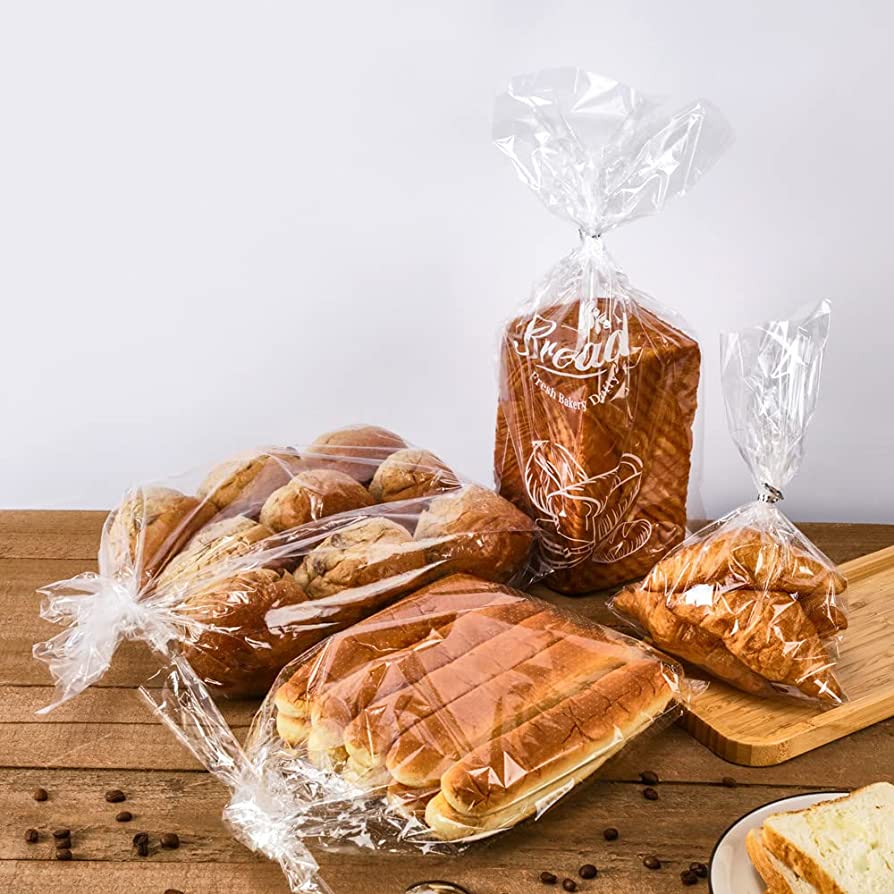
Many bakeries still pack loaves into loose flat bags pulled from a carton. It works, but staff spend seconds on every bag finding the mouth, opening it and squaring the loaf. Wicketed bread bags remove most of that fiddling. They hang in a neat stack, open with a puff of air and tear off once filled, which is why both craft and industrial bakeries are moving to them.
What changes when you move to a wicket
A wicketed bag looks much like a gusseted LDPE flat bag, with one difference: an extended back flap punched with holes that sit on a wire wicket. The stack stays in order next to the slicer or bench. The front panel is shorter than the back, so the mouth is always ready to open. Side gussets expand around the loaf, so a tall tin loaf or a bag of rolls fits without stretching the film.
How wicketed bread bags speed up a bakery
The gain comes in three places. First, hand packing gets quicker because the operator does not search for the opening. Second, a wicket bag can go onto a semi-automatic or fully automatic bagger, where a blower opens it and a pusher slides the loaf in. Third, fewer bags are wasted, since stacked bags are not dropped, creased or pulled out two at a time. In a small bakery that may free a member of staff for baking in the early morning rush. In a plant it lets one line run faster with the same crew.
Bakeries that close bags with twist ties or clips can keep that habit. Others use a heat sealer or tape at the bagger. The choice depends on whether the customer needs to reseal the bag at home.
Freshness: what the bag does and does not do
A closed poly bag slows the loss of moisture from the crumb and keeps the crust from picking up smells. That helps a loaf stay soft for longer at room temperature. Customers should also know that the fridge does not help. Bread goes stale mainly because the starch recrystallises as it cools and ages, and this happens faster at fridge temperature than on the counter. Keeping bread sealed in its bag at room temperature, or freezing it for longer storage, works better. A short line of storage advice printed on the bag gives your product a small advantage.
Before you switch: a short checklist
1. Measure your loaves, including the tallest and longest product you sell, and size the gusset to suit.
2. If you plan to use a bagger, get the wicket hole spacing and lip depth from the machine maker. A sample bag that already runs on the machine is the easiest reference to send.
3. Decide on print. Clear film shows the bread; a one or two colour logo and storage note adds branding. See our private label printing options.
4. Check the food-contact paperwork. For food-contact items Hanpak supplies, the resin complies with FDA 21 CFR 177.1520, and SGS test reports are available for many products.
5. Plan stock. A first bag order usually takes 4 to 6 weeks from sample approval, and repeat orders 3 to 4 weeks, so order the next batch before the shelf runs low. MOQ is flexible and quoted per size and design.
For crusty or hot-from-the-oven products, we usually suggest a few micro-perforations in the bag. They let steam escape so the crust does not go soggy, while the bag still protects the loaf. For soft sandwich bread, an unperforated bag keeps it softer for longer.
From the Hanpak team
Hanpak supplies wicketed bread bags in clear and printed LDPE, with or without gussets. You can see the formats on our wicket and bread bags page. Every pack carries a lot number, and we send production photos while the order runs.
Try wicketed bags on your own loaves
Send us your loaf sizes and how you pack today. We will come back with a quote within 48 hours. Request a quote or samples online or message us on WhatsApp; stock samples are free.