
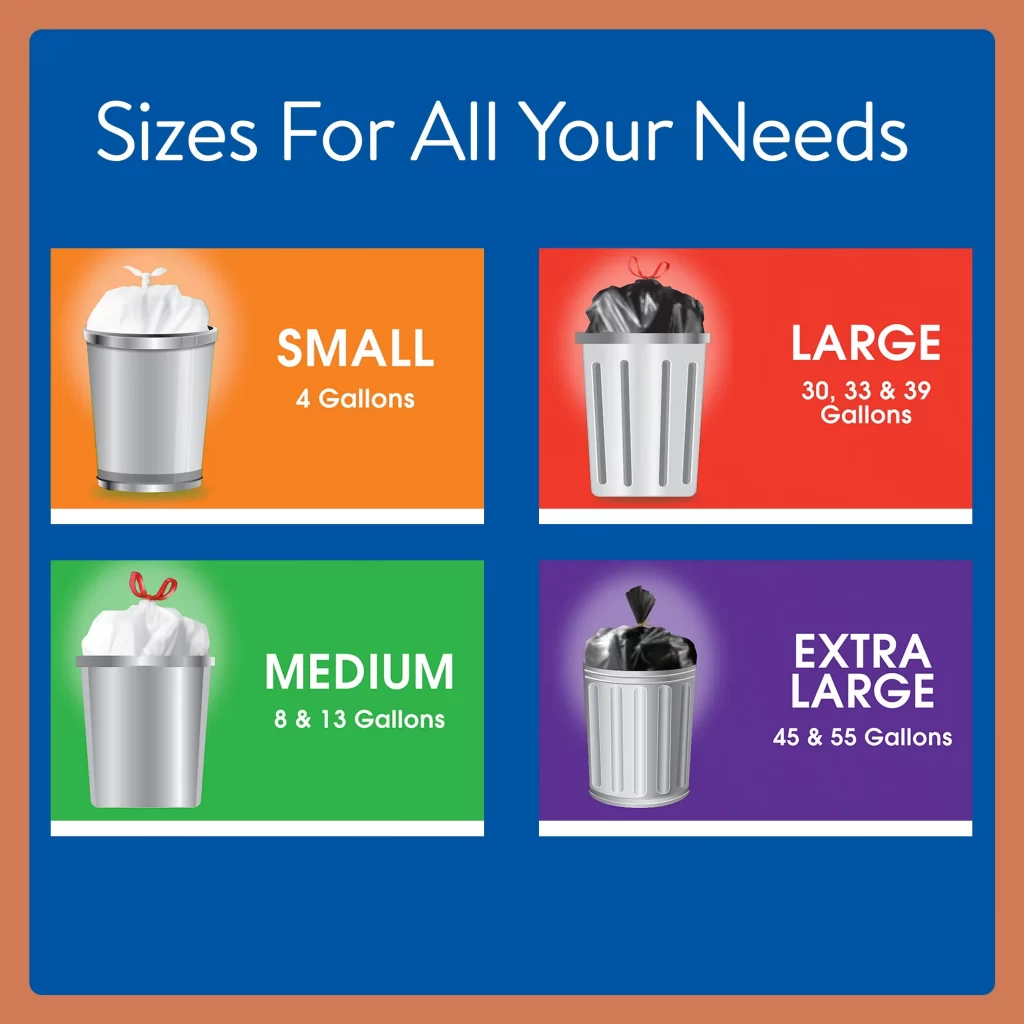
Trash bags in the US are sold by gallon capacity, from about 4 gallons for a bathroom wastebasket to 95–96 gallons for a curbside toter. The most common sizes are 13 gallons (tall kitchen), 33 gallons (32-gallon round can) and 55–60 gallons (large commercial can). What actually decides the fit is the flat width and length of the bag in inches, so use the chart below to match the bag to your can, not just the gallon number.
We make can liners for US janitorial distributors, retail chains and private-label brands, so we see the same question every week: “Which size is a 33-gallon bag, really?” The answer is a range, because each brand cuts a little differently. Here are the sizes the US market actually uses.

Trash bag size chart (US gallons and inches)
Flat size is width × length with the bag laid flat, before it opens. Metric is in brackets. Brands vary by an inch or two for the same gallon rating.
Buying trash bags by the container?
We make drawstring, star seal and heavy-duty trash bags in any gallon or litre size, under your private label.
Drawstring Trash Bags · Star Seal Bags on Roll · Heavy-Duty & Contractor Bags
Request a quote or WhatsApp +84 898 545 893| Bag capacity | Typical can | Flat size, inches (cm) | Usual thickness |
|---|---|---|---|
| 2.6–4 gal (10–15 L) | Bathroom, desk-side wastebasket | 17 × 17 to 17 × 18 (43 × 43 to 43 × 46) | HDPE 6–8 µm or LLDPE 0.5–0.7 mil |
| 7–10 gal (26–38 L) | Office wastebasket | 24 × 24 (61 × 61) | HDPE 6–8 µm or LLDPE 0.5–0.7 mil |
| 12–16 gal (45–61 L) | 16-gal office round, small kitchen can | 24 × 33 (61 × 84) | HDPE 8–10 µm or LLDPE 0.6–0.8 mil |
| 13 gal (49 L) | Tall kitchen can | 24 × 27 to 24 × 31 (61 × 69 to 61 × 79) | LLDPE 0.7–0.9 mil, usually drawstring |
| 20–30 gal (76–114 L) | Medium round or square can | 30 × 36 to 30 × 37 (76 × 91 to 76 × 94) | HDPE 10–13 µm or LLDPE 0.8–1.2 mil |
| 32–33 gal (121–125 L) | 32-gal round can, 23-gal Slim Jim | 33 × 39 to 33 × 40 (84 × 99 to 84 × 102) | HDPE 13–16 µm or LLDPE 1.0–1.5 mil |
| 40–45 gal (151–170 L) | 44-gal round can | 40 × 46 to 40 × 48 (102 × 117 to 102 × 122) | HDPE 13–16 µm or LLDPE 1.2–1.5 mil |
| 42 gal contractor (159 L) | Job site, demolition | 33 × 48 (84 × 122) | LLDPE 2.5–3.0 mil |
| 55–60 gal (208–227 L) | 55-gal drum, 60-gal can | 36 × 58 to 38 × 60 (91 × 147 to 97 × 152) | HDPE 16–22 µm or LLDPE 1.5–2.0 mil |
| 64–65 gal (242–246 L) | 65-gal wheeled toter | 50 × 48 (127 × 122) | HDPE 16–22 µm or LLDPE 1.5–2.0 mil |
| 95–96 gal (360–363 L) | 96-gal curbside toter | 61 × 68 (155 × 173) | HDPE 22 µm or LLDPE 2.0–3.0 mil |
Two notes from the US trade. The 38 × 58 inch, 60-gallon liner is the single most common commercial size. And a 55-gallon round can with a wide rim often takes a 43 × 47 bag instead, which is shorter and wider than the usual 55–60 gallon cut. For more sizes, a liner calculator and the mil-to-micron table, see our full trash bag size chart.
What each common size is for
4 gallon and 7–10 gallon
Bathrooms, offices, hotel rooms, desk-side bins. The waste is light and dry, so a thin HDPE liner on a roll does the job at the lowest cost per bag. This is where janitorial buyers save the most money, because these bags are used in the thousands.
13 gallon (tall kitchen)
The standard US home kitchen bag. Almost all retail 13-gallon bags have a drawstring, and many are scented. Food waste is wet and has sharp bits (bones, can lids, plastic forks), so these are made from LLDPE, not HDPE. If you buy 13-gallon bags for a store brand, the drawstring style and box design matter as much as the size. See our drawstring trash bags on roll.
20–30 gallon
Medium cans in break rooms, classrooms, waiting areas and garages. Also the size many households use for yard clean-up. A 30 × 36 or 30 × 37 bag fits most of these cans.
32–33 gallon
Fits the 32-gallon round commercial can and the 23-gallon Slim Jim style rectangular can. It is also a common outdoor can size at homes. For the rectangular Slim Jim, a 33 × 39 or 33 × 40 bag fits, but some buyers prefer a gusseted or rectangle-cut liner so the corners don’t bunch.
40–45 gallon
The 44-gallon round can is everywhere in restaurants, schools and factories. A 40 × 46 liner is the standard fit. If staff complain it slips into the can when full, go to 40 × 48 for more overhang.
55–60 gallon
Large cans in warehouses, kitchens, parks and events, and 55-gallon drums. The 38 × 58 star seal bag is the workhorse here. Heavy, wet loads need LLDPE at 1.5 mil or more. Light, bulky waste like paper and packaging can go in a 16–22 micron HDPE bag. See our heavy duty trash can liners.
64–65 and 95–96 gallon
Wheeled toters. Many US households don’t line their curbside cart at all, but commercial users, property managers and some municipalities do. These are big bags, so thickness drives the price more than at any other size.
42 gallon contractor bags
Not a can liner. Contractor bags are thick (usually 2.5–3.0 mil LLDPE) and built for drywall, wood scraps, roofing and demolition debris. Don’t use them where a regular liner will do. You are paying for plastic you don’t need.
How to measure your can
If the gallon number on the can is missing or the bags you have don’t fit, measure the can. It takes two minutes.
- Bag width: measure around the rim (the circumference) and divide by 2. For a square or rectangular can, add all four sides and divide by 2.
- Bag length: can height + half the bottom diameter + 3–4 inches of overhang to fold over the rim. For a square can, use half the bottom diagonal instead of half the diameter.
- If staff tie the bag closed in the can: add the full bottom diameter instead of half.
Example: a 44-gallon round can with a 24 inch rim and 31.5 inch height. Width: 3.14 × 24 ÷ 2 = 37.7 inches. Length: 31.5 + 12 + 4 = 47.5 inches. The closest standard size is 40 × 46 or 40 × 48.
Gallon size vs flat size: why bags don’t fit
Most fit complaints we hear come from one of three things.
- Star seal vs gusseted. A star seal bag is sold by its flat width (for example 38 × 58). A gusseted bag is written as width + gusset + gusset × length, so it looks narrower on paper for the same can. Compare the opened circumference, not the printed width.
- Brand differences. One brand’s “33 gallon” is another’s “30 gallon”. If your current bag fits well, measure it flat and order that size.
- Too little overhang. A bag that is long enough on paper can still slide into the can once it is full and heavy. Three to four inches of overhang is the minimum for a can that gets heavy loads.
Also check the box. A good liner box shows the actual flat size, the thickness in mil or micron, and the bag count. If a “33 × 40, 1.25 mil” box contains bags that measure 33 × 35 and 1.1 mil, you are paying for plastic you did not get.
Picking thickness for the size
Size and thickness go together. Bigger bags carry more weight, so they need more film. But what goes in the bag matters more than the gallon size.
- HDPE (sold in microns): stiff, crinkly, strong for its weight and the cheapest per bag. Best for paper and dry office waste. Tears quickly once it is punctured.
- LLDPE (sold in mil): soft and stretchy. It gives before it breaks, so it handles food waste, glass, sharp edges and heavy loads better.
Going thinner than the job needs is the most common reason bags split. Going thicker than needed is the most common way buyers overspend. Our trash bag thickness guide goes deeper on mil, micron and resin choice.
Buying tips for importers and distributors
- Order by flat size and thickness, not gallon name. Write “38 × 58 in, 16 µm HDPE, star seal, black, on roll” on the PO. “60 gallon bag” alone leaves too much open.
- Pick the seal for the can. Star seal for round and square cans, flat bottom seal for small cans, drawstring for 13-gallon kitchen bags. Our black star seal bags on roll cover most commercial can sizes.
- Decide roll or flat pack. Rolls are faster to dispense in janitorial work. Folded flat packs and interleaved rolls are better for retail boxes. We interleave drawstring bags only.
- Think about the box. For store brands we print your box design, barcode labels and shipping marks. See private label and custom printing.
- Get samples first. We send free samples from stock so you can test fit in your own cans before the first order.
We make can liners to any width, length and thickness in black, clear, white or custom colors, so you are not limited to the sizes in the chart. Lead time is 4–6 weeks for a first printed order and 3–4 weeks for repeats. See the full range in our trash bags category.
FAQ
What size is a 13 gallon trash bag?
Usually about 24 inches wide and 27 to 31 inches long (61 × 69 to 61 × 79 cm), depending on the brand. It fits a standard tall kitchen can of 12 to 16 gallons.
What size trash bag fits a 32 gallon can?
A 33-gallon bag, usually 33 × 39 or 33 × 40 inches. If the bag slips into the can when it is full, choose the 40-inch length for more overhang.
What size bag fits a 55 gallon drum?
A 36 × 58 or 38 × 58 inch bag fits most 55-gallon drums with enough overhang. Wide-rim 55-gallon cans sometimes need 43 × 47 instead. Measure the rim and use the formula above if you are unsure.
What is the most common commercial trash bag size?
The 38 × 58 inch liner for 55–60 gallon cans. In homes, the 13-gallon tall kitchen bag is the most common.
Are 30 gallon and 33 gallon bags the same?
No. A 30-gallon bag is usually around 30 × 36 inches and a 33-gallon bag around 33 × 39. The 33-gallon bag is wider and fits a 32-gallon round can. A 30-gallon bag on a 32-gallon can will be tight and may slip in.
Send us your can size, or the flat size and thickness of the bag you use now, plus what goes in it. We will suggest the lightest bag that still holds and quote it on FOB, CFR or CIF terms. Contact us here.
Buying trash bags by the container?
We make drawstring, star seal and heavy-duty trash bags in any gallon or litre size, under your private label.
Drawstring Trash Bags · Star Seal Bags on Roll · Heavy-Duty & Contractor Bags
Request a quote or WhatsApp +84 898 545 893