
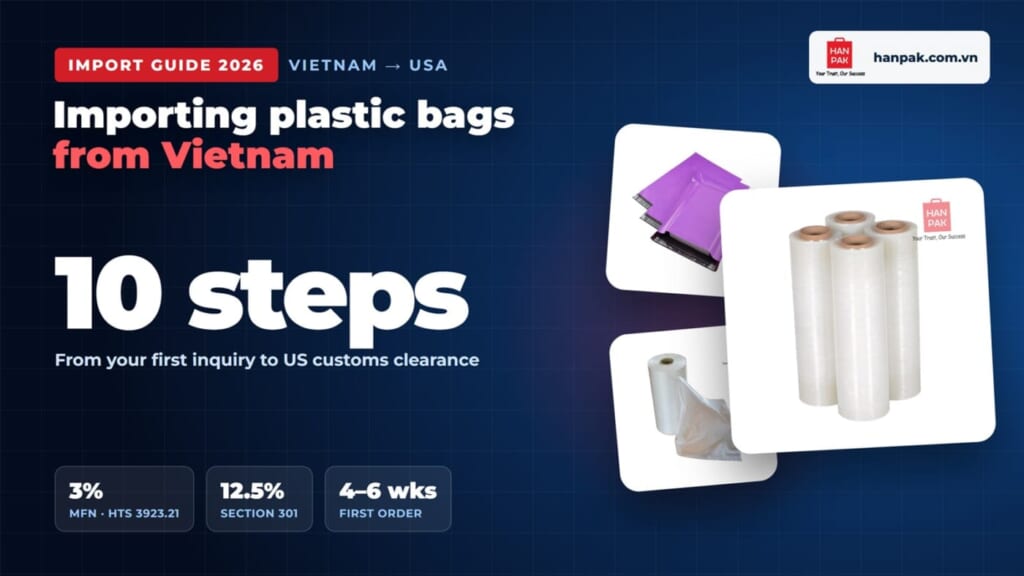
Importing plastic bags from Vietnam is not hard, but small mistakes cost real money: a vague inquiry gets you the wrong quote, a missed ISF filing gets you a penalty, and the wrong HTS code can add duties you did not plan for. This guide walks a US importer through the whole process, from the first email to the container clearing customs. It is written for distributors, Amazon sellers, janitorial suppliers and grocers buying their first or second container.
Step 1: Choose a manufacturer or a trading company
Both can work. The difference is control.
- A manufacturer runs the extruders, printers and bag machines. You talk to the people who set the gauge and match your Pantone colour. Questions about film, sealing or print get answered from the floor, not passed along.
- A trading company buys from several factories. That helps if you need many unrelated items in small amounts. The trade-off: you often do not know which plant made your goods, and a repeat order may come from a different one.
Ask a supplier directly: “Do you own the extrusion and printing lines?” Ask for photos of the lines and for the quality standard they work to. We are a manufacturer; our plants follow JIS and ISO 9001, and every pack carries a lot number so a problem can be traced back to a production run.
Step 2: Send an inquiry a factory can actually quote
“Price for T-shirt bags?” gets you a guess. Almost everything we make is cut to custom size, so the factory needs the details. Send these:
| What to send | Example | Why it matters |
|---|---|---|
| Product type | T-shirt bag, produce roll, trash bag on roll, stretch film | Decides the machine and process |
| Size (W x L, plus gusset) | 11.5″ + 6.5″ x 21″ | Width x length, gusset stated separately |
| Thickness | 0.5 mil or 12 micron | The biggest driver of cost and strength |
| Material | HDPE, LDPE, LLDPE, recycled content | Changes feel, clarity and strength |
| Colour and print | White, 2 colours one side, Pantone 186C | Plate count and press setup |
| Packing | Your box label, carton marks, pallet or floor-loaded | Affects how much fits in the container |
| Quantity range | First order and expected yearly volume | Lets the factory plan runs |
| Destination port | Los Angeles, Savannah, Houston | Needed for any CIF or CFR quote |
One tip on thickness: US buyers think in mil, Asian factories often think in micron. 1 mil = 25.4 micron. Write both if you can, and say whether it is per wall or total.
Step 3: Get samples, then approve a spec sheet
Ask for samples before you talk price in detail. We send free samples that are close to your spec. A sample shows you material, strength and finish.
Once the price is agreed, you should get a spec sheet: size, thickness, material, colour, print, packing. Read it line by line. This is the document both sides will check the goods against. For printed bags, approve a digital proof with Pantone references. For a new or tricky item, ask for a pre-production sample from the real run before the bulk is made. It costs a few days and saves arguments later.
Step 4: Agree payment terms
Most Vietnamese factories work by T/T (bank wire). The usual pattern is a deposit to start production and the balance before the original documents are released or against a copy of the bill of lading. Exact percentages vary by supplier and by how long you have worked together. Get the terms in writing on the proforma invoice, and check that the beneficiary name on the bank details matches the company name on your contract.
Step 5: Pick your Incoterm
- FOB: the factory delivers the goods onto the ship in Vietnam. You book and pay the ocean freight through your own forwarder. Best if your forwarder has good contract rates.
- CFR / CIF: the factory books freight to your port (CIF adds insurance). Less work for you. You still pay destination charges, duties and the customs broker.
- DDP: the seller handles everything, including US duties. Convenient, but you lose sight of what you paid in duty, and the seller has to act as or arrange the importer of record. Few factories offer it.
Ask for FOB and CIF side by side and compare with your forwarder. Rates change week to week; our freight rates update tracks the current market.
Step 6: Plan lead time and fill the container
Our lead time is 4–6 weeks for a first order and 3–4 weeks for a repeat, counted from approved artwork and deposit. Add ocean transit and clearance on top.
Plastic bags are light and bulky, so freight is a big part of your landed cost. You do not need a full container of one item. Mixing products in one container works well: stretch film, trash bags on roll, produce bags on roll and poly mailers can share one box. You pay the same freight as a half-empty container of a single item.
Printed bags reorder faster. We keep printing plates for up to 2 years, so a reorder within that time has no new plate charge.
Watch the calendar. Lunar New Year (Tết) falls in early February 2027. Factories and forwarders slow down for one to two weeks, and freight usually climbs in January. See our Lunar New Year 2027 order deadline.
Step 7: Check the US duty before you order
Know your landed cost before you sign. The main lines for plastic bags and film:
| Product | HTS heading | MFN duty | Section 301 (Vietnam) |
|---|---|---|---|
| Bags of polyethylene (T-shirt, trash, produce, mailers) | 3923.21 | 3% | 12.5% since 24 July 2026 |
| PE film and sheet (stretch film, PE film) | 3920.10 | 4.2% | 12.5% since 24 July 2026 |
The big one to watch: polyethylene retail carrier bags (T-shirt bags) from Vietnam are under antidumping and countervailing duty orders (A-552-806 and C-552-805). The orders are aimed at retail carrier bags, not at film or most other bag types, but the scope wording is detailed. Have your broker check any bag with handles before you order. Entries subject to AD/CVD must go through formal entry, and the duty deposits are paid when the goods enter. Full details are in our post on US tariffs on plastic bags from Vietnam in 2026.
Step 8: File the ISF and set up a customs bond
For ocean shipments to the US, you (or your broker) must file an Importer Security Filing (ISF, “10+2”) at least 24 hours before the goods are loaded onto the US-bound vessel in Vietnam. CBP can issue penalties of $5,000 per violation for late or inaccurate filings, plus holds and inspections. Ask the factory for the seller, manufacturer, stuffing location and consolidator details early so your broker has them.
You also need a customs bond for formal entries (generally shipments over $2,500). A single-entry bond covers one shipment. If you import more than a few times a year, a continuous bond is usually cheaper; CBP sets the minimum at $50,000 or 10% of duties, taxes and fees paid in the past 12 months, whichever is greater. Your broker can arrange either.
Step 9: Inspect before loading
Do not wait until the container lands. Before the balance payment, check the goods against the approved spec sheet: size, thickness, print, count per pack and carton marks. You can hire a third-party inspection company or ask the factory for photos and measurements by lot number. For a first order, an independent inspection is worth the fee.
Step 10: Collect the right documents
Your broker will need:
- Commercial invoice with HTS code, value, Incoterm and country of origin.
- Packing list with cartons, weights and marks.
- Bill of lading (original, telex release or sea waybill).
- Certificate of origin showing Vietnam origin.
- FDA-compliant statement for food-contact items such as produce bags. Our food-contact items are FDA-compliant (21 CFR 177.1520).
Shipping to the EU too? The EU–Vietnam Free Trade Agreement (EVFTA) can cut duty to zero, but only with valid proof of origin. Tell us at order stage so the paperwork is right.
Customs information here is general and can change. Confirm duty rates, scope and filing rules with your licensed customs broker before you ship.
Frequently asked questions
Do I need a customs broker to import plastic bags from Vietnam?
It is not legally required, but almost every small or mid-size importer uses one. A broker files the ISF and entry, arranges the bond and catches classification problems before they cost you.
Are T-shirt bags from Vietnam subject to antidumping duty?
Yes. Polyethylene retail carrier bags from Vietnam are covered by AD/CVD orders A-552-806 and C-552-805, on top of the 3% MFN duty and the 12.5% Section 301 duty. Your broker can confirm the current deposit rate.
Can I mix different bags and stretch film in one container?
Yes, from the same factory. Each item still needs its own spec sheet and its own line on the invoice and packing list, since they may have different HTS codes.
How long does it take from order to delivery in the US?
With us, production takes 4–6 weeks for a first order and 3–4 weeks for a repeat, from approved artwork and deposit. Add ocean transit to your port and a few days for clearance and trucking.
Can you make bags with recycled content?
Yes, on request. It is most common for trash bags. Tell us the recycled share you need when you ask for a quote.
Ready to price your first container? Send us your spec or WhatsApp +84 898 545 893. You can also see our T-shirt bags and pallet covers, or follow freight and tariff news on our market updates page.
Sources: CBP, Importer Security Filing “10+2”; CBP, ISF FAQ; CBP, How CBP Sets Bond Amounts (2024); CBP, formal entry threshold; USITC Harmonized Tariff Schedule.